JN0-351 Dumps Deutsch & JN0-351 Vorbereitung
Wiki Article
Laden Sie die neuesten EchteFrage JN0-351 PDF-Versionen von Prüfungsfragen kostenlos von Google Drive herunter: https://drive.google.com/open?id=11Ux0IZLZCAhQg0O2MHDvM1GU7pDYJIOO
Wenn Sie sich um die Juniper JN0-351 Zertifizierungsprüfung bemühen, kann EchteFrage Ihnen helfen, Ihren Traum zu verwirklichen. Die Übungen zur Juniper JN0-351 Zertifizierungsprüfung werden von der Praxis prüft. Die Schulungsunterlagen zur Juniper JN0-351 Zertifizierungsprüfung sind von guter Qualität, die Ihnen helfen, die Juniper JN0-351 Zertifizierungsprüfung zu bestehen und ein IT-Expert zu werden.
Falls Sie nicht wissen, wie die Juniper JN0-351 Prüfungen hocheffektiv zu bestehen, können Sie eine gute Online-Bildung auswählen, sehr effektiv diese Juniper JN0-351 Zertifizierungsprüfungen zu bestehen. Wir EchteFrage bemühen uns um Prüfungsteilnehmer originale Zertifizierungsunterlagen anzubieten und Die Dumps zur Juniper JN0-351 Zertifizierungsprüfung von EchteFrage sind die Produkte, die von Lieferanten Genehmigungen bekommen und vielfältige Inhalte abdecken. Damit können Sie viel Zeit und Energie sparen. Und es kann Ihnen gewährleisten, einmal Erfolg zu machen. Ansonst geben wir Ihnen voll Geld zurück.
Die seit kurzem aktuellsten Juniper JN0-351 Prüfungsinformationen, 100% Garantie für Ihen Erfolg in der Prüfungen!
Vielleicht können Sie auch die relevanten Juniper JN0-351 Schulungsunterlagen in anderen Büchern oder auf anderen Websites finden. Aber wenn Sie die Produkte von EchteFrage mit ihnen vergleichen, würden Sie herausfinden, dass unsere Produkte mehr Wissensgebiete umfassen. Sie können auch im Internet teilweise die Fragen und Antworten zur Juniper JN0-351 Zertifizierungsprüfung kostenlos herunterladen, so dass Sie die Qualität unserer Produkte testen können. Die Gründe, dass EchteFrage exklusiv umfassende Materialien von guter Qualität bieten können, liegt darin, dass wir ein exzellentes Expertenteam hat. Sie bearbeiten die neuesten Fragen und Antworten zur Juniper JN0-351 Zertifizierungsprüfung nach ihren IT-Kenntnissen und Erfahrungen. Deshalb sind die Fragen und Antworten zur Juniper JN0-351 Zertifizierungsprüfung von EchteFrage bei den Kandidaten ganz beliebt.
Juniper JN0-351 Prüfungsplan:
| Thema | Einzelheiten |
|---|---|
| Thema 1 |
|
| Thema 2 |
|
| Thema 3 |
|
| Thema 4 |
|
| Thema 5 |
|
| Thema 6 |
|
| Thema 7 |
|
| Thema 8 |
|
Juniper Enterprise Routing and Switching, Specialist (JNCIS-ENT) JN0-351 Prüfungsfragen mit Lösungen (Q85-Q90):
85. Frage
Which statement is true about Layer 2 firewall filters on EX Series switches?
- A. They are stateless and evaluated by the control plane.
- B. They are stateless and evaluated by the forwarding plane.
- C. They are stateful and evaluated by the control plane.
- D. They are stateful and evaluated by the forwarding plane.
Antwort: B
86. Frage
Exhibit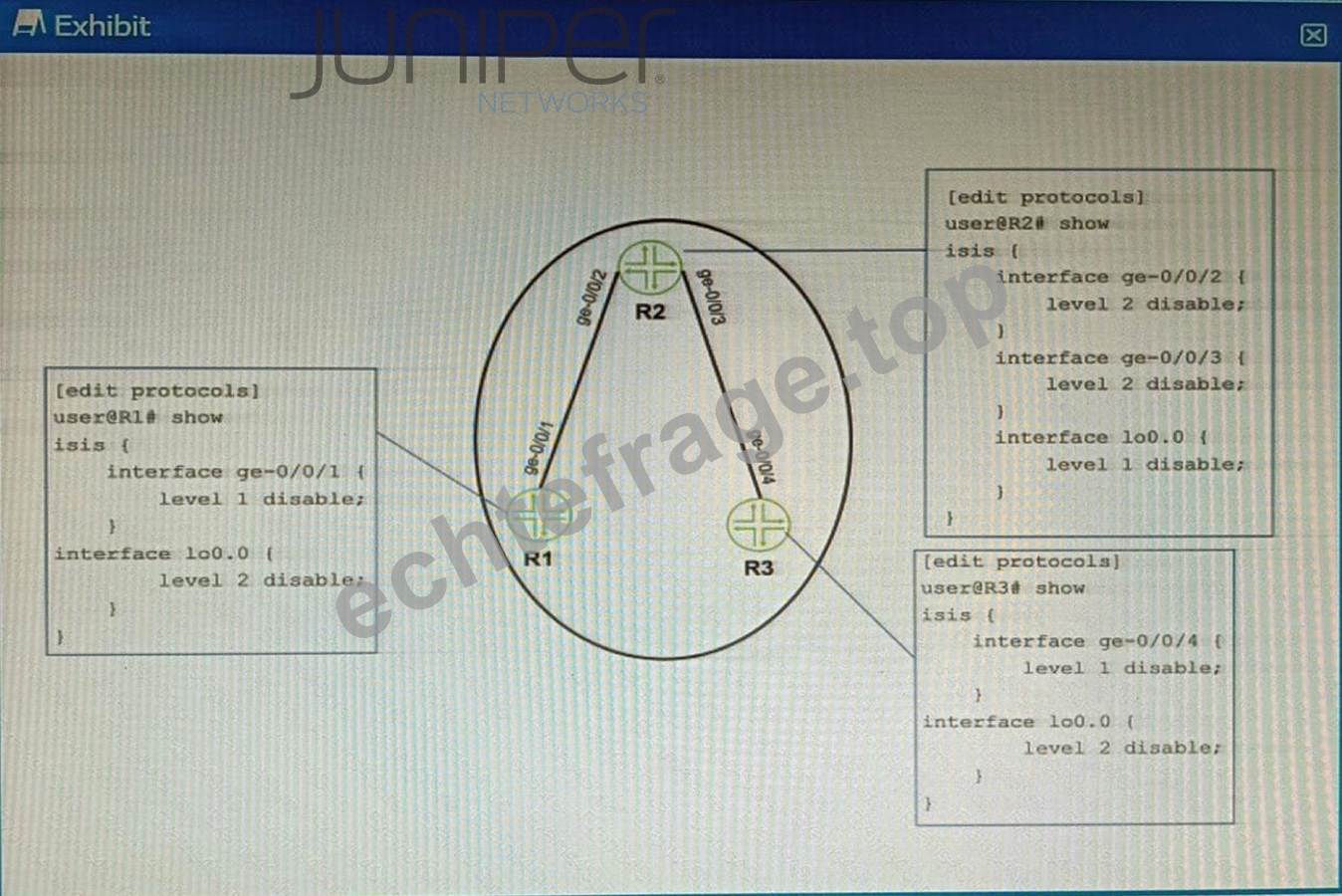
Referring to the exhibit, which two configuration changes must you apply for packets to reach from R1 to R3 using IS-IS? (Choose two.)
- A. On R1, enable Level 1 on the ge-0/0/1 interface.
- B. On R3 disable Level 2 on the ge-0/0/4 interface.
- C. On R1, disable Level 2 on the ge-0/0/1 interface.
- D. On R3 enable Level 1 on the ge-0/0/4 interface
Antwort: A,D
Begründung:
Explanation
A: On R1, enable Level 1 on the ge-0/0/1 interface. In IS-IS, both levels (Level 1 and Level 2) are enabled by default when you enable IS-IS on an interface1. Level 1 systems route within an area2. If the destination is outside an area, Level 1 systems route toward a Level 2 system2. Therefore, enabling Level 1 on the ge-0/0/1 interface on R1 would allow packets to reach from R1 to R3.
D: On R3 enable Level 1 on the ge-0/0/4 interface Similarly, enabling Level 1 on the ge-0/0/4 interface on R3 would allow packets to reach from R1 to R3.
These explanations are based on the IS-IS configuration documents and learning resources available at Juniper Networks1 and Cisco34.
87. Frage
You are deploying an EX Series switch with a Wi-Fi access point. The access point needs all untagged traffic to use a specific VLAN.
In this scenario, which feature should you enable on the switch port?
- A. voice VLAN
- B. native VLAN
- C. VLAN tagging
- D. flexible VLAN tagging
Antwort: B
Begründung:
According to the Juniper documentation1, a native VLAN is a VLAN that carries untagged traffic on a trunk port. A Wi-Fi access point may need a native VLAN to associate untagged traffic with a specific VLAN, such as the management VLAN. On Juniper EX Series switches, you can enable a native VLAN on a switch port by setting the interface-mode to trunk and specifying a native-vlan-id. For example, the following configuration enables a native VLAN with ID 1 on the switch port ge-0/0/12:
set interfaces ge-0/0/1 unit 0 family ethernet-switching interface-mode trunk set interfaces ge-0/0/1 unit 0 family ethernet-switching vlan members all set interfaces ge-0/0/1 unit 0 family ethernet-switching native-vlan-id 1 The other options are not correct because they do not address the requirement of untagged traffic. VLAN tagging is the process of adding a VLAN identifier to a frame, which is not needed for untagged traffic.
Flexible VLAN tagging is a feature that allows multiple VLAN tags on a single interface, which is not relevant for this scenario. Voice VLAN is a feature that allows voice traffic to be separated from data traffic on a switch port, which is not related to untagged traffic or Wi-Fi access points. References: Understanding Native VLANs on Trunks | Junos OS, Configuring a Native VLAN on a Trunk Port | Junos OS
88. Frage
Exhibit.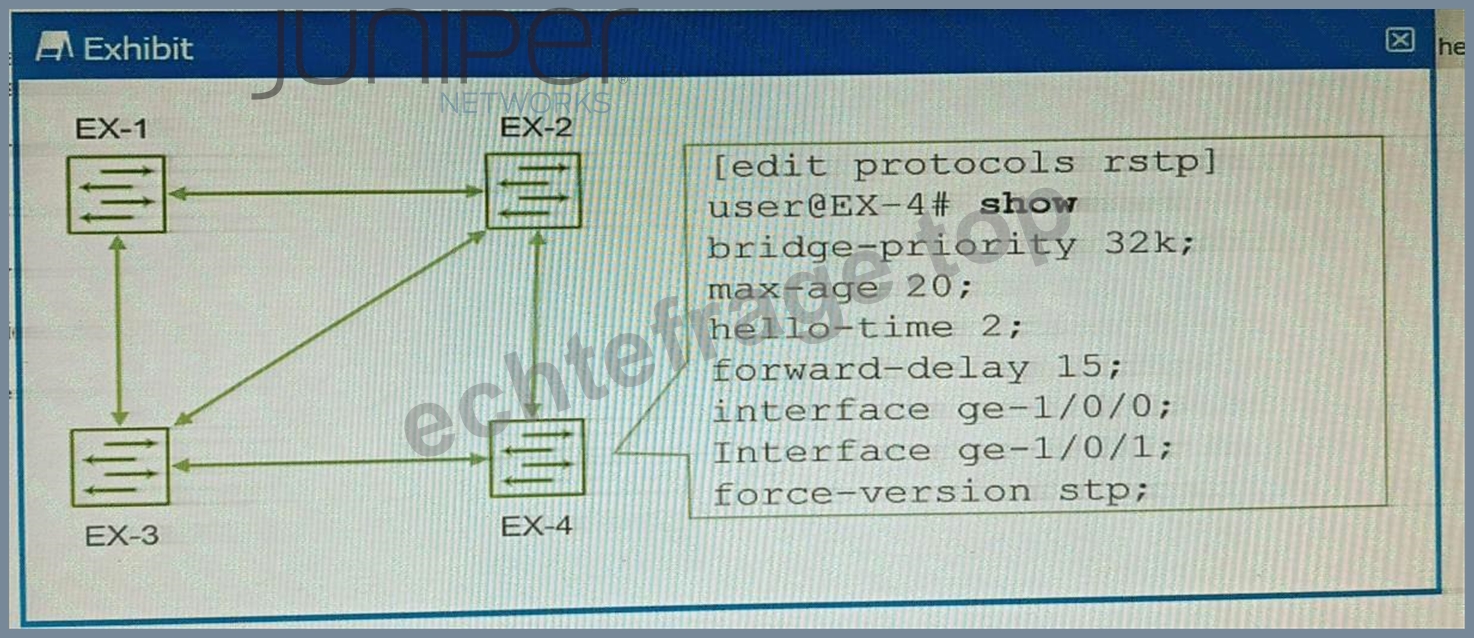
You have configured the four EX Series switches with RSTP, as shown in the exhibit. You discover that whenever a link between switches goes up or down, the switches take longer than expected for RSTP to converge, using the default settings.
In this scenario, which action would solve the delay in RSTP convergence?
- A. The max-age must be increased to 20
- B. The hello-time must be increased.
- C. The bridge priority for EX-4 must be set at 4000.
- D. The force-version must be removed.
Antwort: D
Begründung:
* The exhibit shows the configuration of RSTP on EX-4, which has the command force-version stp
. This command forces the switch to use the legacy STP protocol instead of RSTP, even though the switch supports RSTP 1 . This means that EX-4 will not be able to take advantage of the faster convergence and enhanced features of RSTP, such as edge ports, link type, and proposal/agreement sequence 2 .
* The other switches in the network are likely to be running RSTP, as it is the default protocol for EX Series switches 3 . Therefore, there will be a compatibility issue between EX-4 and the other switches, which will result in longer convergence times and suboptimal performance. The switch will also generate a warning message that says "Warning: STP version mismatch with neighbor" when it receives a BPDU from a RSTP neighbor 1 .
* To solve this problem, the force-version command must be removed from EX-4, so that it can run RSTP natively and interoperate with the other switches in the network. This will enable faster convergence and better stability for the network topology. To remove the command, you can use the delete protocols rstp force-version command in configuration mode 1 .
89. Frage
The ISP1.inet.0 route table has currently no routes in it.
What will happen when you commit the configuration shown on the exhibit?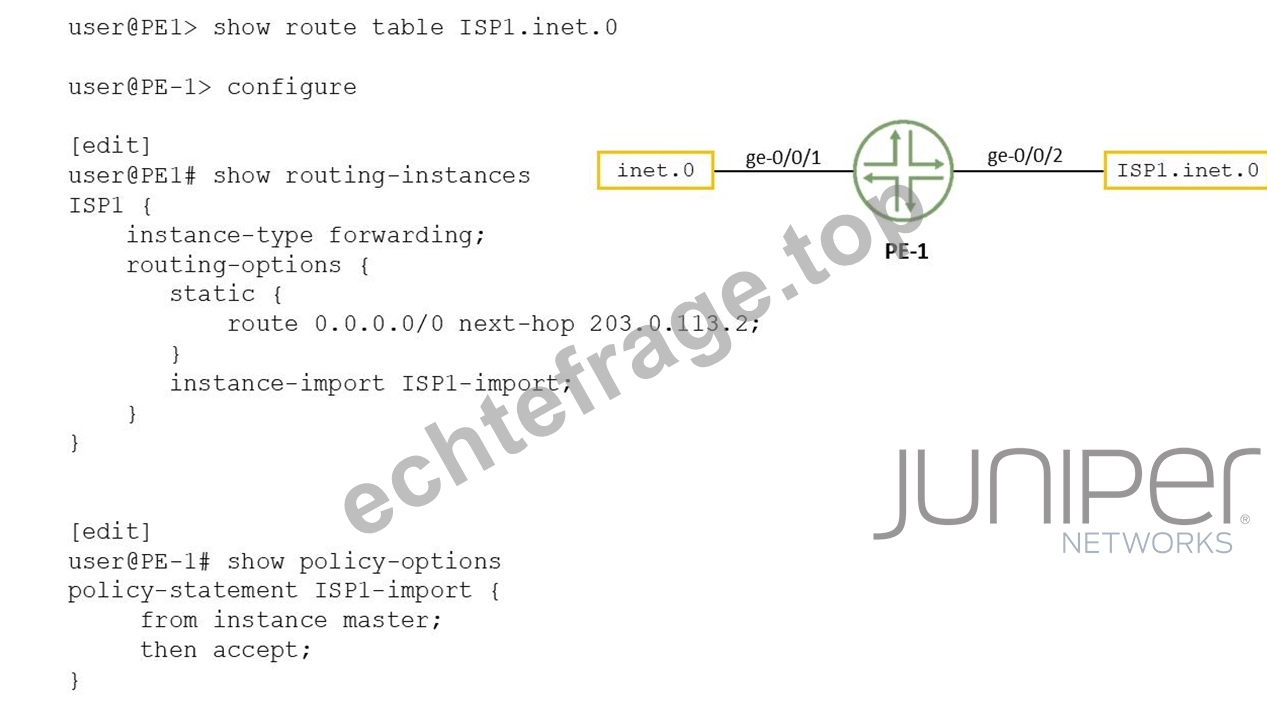
- A. The ISP1.inet.0 route table will be imported into the inet.0 route table.
- B. The ISP1.inet.0 route table will be completely overwritten by the inet.0 route table.
- C. The inet.0 route table will be imported into the ISP1.inet.0 route table.
- D. The inet.0 route table will be completely overwritten by the ISP1.inet.0 route table.
Antwort: C
Begründung:
The configuration shown in the exhibit is an example of a routing instance of type virtual-router. A routing instance is a collection of routing tables, interfaces, and routing protocol parameters that create a separate routing domain on a Juniper device. A virtual-router routing instance allows administrators to divide a device into multiple independent virtual routers, each with its own routing table.
The configuration also includes a rib-group statement, which is used to import routes from one routing table to another. A rib-group consists of an import-rib statement, which specifies the source routing table, and an export-rib statement, which specifies the destination routing table. In this case, the rib-group name is inet-to-ispi, and the import-rib statement specifies inet.0 as the source routing table. The export-rib statement specifies ispi.inet.0 as the destination routing table.
This means that the routes from inet.0 will be imported into ispi.inet.0.
90. Frage
......
Die Fragen und Antworten zur Juniper JN0-351 Zertifizierungsprüfung von EchteFrage sind den echten Prüfung sehr ähnlich. Wenn Sie die Prüfungsfragen und Antworten von EchteFrage wählen, bieten wir Ihnen einen einjährigen kostenlosen Update-Service. Wir versprechen, dass Sie die Juniper JN0-351 Prüfung 100% bestehen können. Sonst erstatteten wir Ihnen die gesammte Summe zurück.
JN0-351 Vorbereitung: https://www.echtefrage.top/JN0-351-deutsch-pruefungen.html
- JN0-351 Studienmaterialien: Enterprise Routing and Switching, Specialist (JNCIS-ENT) - JN0-351 Zertifizierungstraining ⛲ Suchen Sie auf ▛ www.zertpruefung.ch ▟ nach ➡ JN0-351 ️⬅️ und erhalten Sie den kostenlosen Download mühelos ????JN0-351 Tests
- JN0-351 Fragen Beantworten ⛑ JN0-351 Dumps Deutsch ???? JN0-351 Lerntipps ???? Öffnen Sie die Webseite ➤ www.itzert.com ⮘ und suchen Sie nach kostenloser Download von “ JN0-351 ” ????JN0-351 Schulungsunterlagen
- Die anspruchsvolle JN0-351 echte Prüfungsfragen von uns garantiert Ihre bessere Berufsaussichten! ???? Suchen Sie auf ⏩ www.zertpruefung.ch ⏪ nach ▷ JN0-351 ◁ und erhalten Sie den kostenlosen Download mühelos ????JN0-351 Prüfungsfragen
- JN0-351 Praxisprüfung ???? JN0-351 Zertifizierung ???? JN0-351 Prüfungsfragen ???? Öffnen Sie die Webseite ➡ www.itzert.com ️⬅️ und suchen Sie nach kostenloser Download von ➠ JN0-351 ???? ????JN0-351 Prüfungsinformationen
- JN0-351 Trainingsmaterialien: Enterprise Routing and Switching, Specialist (JNCIS-ENT) - JN0-351 Lernmittel - Juniper JN0-351 Quiz ♣ Suchen Sie einfach auf 【 www.zertpruefung.ch 】 nach kostenloser Download von ➤ JN0-351 ⮘ ⛪JN0-351 Examengine
- JN0-351 Schulungsunterlagen ???? JN0-351 Testengine ???? JN0-351 Online Prüfungen ???? Suchen Sie jetzt auf ( www.itzert.com ) nach ➠ JN0-351 ???? und laden Sie es kostenlos herunter ????JN0-351 Testing Engine
- JN0-351 Online Prüfung ???? JN0-351 Zertifizierung ???? JN0-351 Testengine ???? Öffnen Sie die Website 《 www.itzert.com 》 Suchen Sie ➥ JN0-351 ???? Kostenloser Download ????JN0-351 Prüfungsinformationen
- JN0-351 Schulungsunterlagen ???? JN0-351 Fragen Beantworten ???? JN0-351 Lerntipps ⤵ Suchen Sie auf der Webseite ☀ www.itzert.com ️☀️ nach [ JN0-351 ] und laden Sie es kostenlos herunter ????JN0-351 Online Prüfung
- JN0-351 Zertifizierungsantworten ???? JN0-351 Dumps Deutsch ???? JN0-351 Praxisprüfung ???? Sie müssen nur zu 【 de.fast2test.com 】 gehen um nach kostenloser Download von ➤ JN0-351 ⮘ zu suchen ????JN0-351 Unterlage
- JN0-351 Unterlagen mit echte Prüfungsfragen der Juniper Zertifizierung ???? Geben Sie ⏩ www.itzert.com ⏪ ein und suchen Sie nach kostenloser Download von ➥ JN0-351 ???? ⚔JN0-351 Examengine
- JN0-351 Zertifizierungsantworten ???? JN0-351 Testing Engine ???? JN0-351 Praxisprüfung ???? Öffnen Sie ✔ www.zertpruefung.ch ️✔️ geben Sie ➤ JN0-351 ⮘ ein und erhalten Sie den kostenlosen Download ????JN0-351 Buch
- rajandjqm228198.dekaronwiki.com, minibookmarks.com, myportal.utt.edu.tt, myportal.utt.edu.tt, myportal.utt.edu.tt, myportal.utt.edu.tt, myportal.utt.edu.tt, myportal.utt.edu.tt, myportal.utt.edu.tt, myportal.utt.edu.tt, myportal.utt.edu.tt, myportal.utt.edu.tt, elodiegrup075371.wikigiogio.com, deannacjry389912.blogtov.com, geraldbzby456607.blazingblog.com, bookmarkspy.com, safiyaqfqg739268.blogsumer.com, jessesjuo415613.wikiexcerpt.com, mysterybookmarks.com, Disposable vapes
BONUS!!! Laden Sie die vollständige Version der EchteFrage JN0-351 Prüfungsfragen kostenlos herunter: https://drive.google.com/open?id=11Ux0IZLZCAhQg0O2MHDvM1GU7pDYJIOO
Report this wiki page